
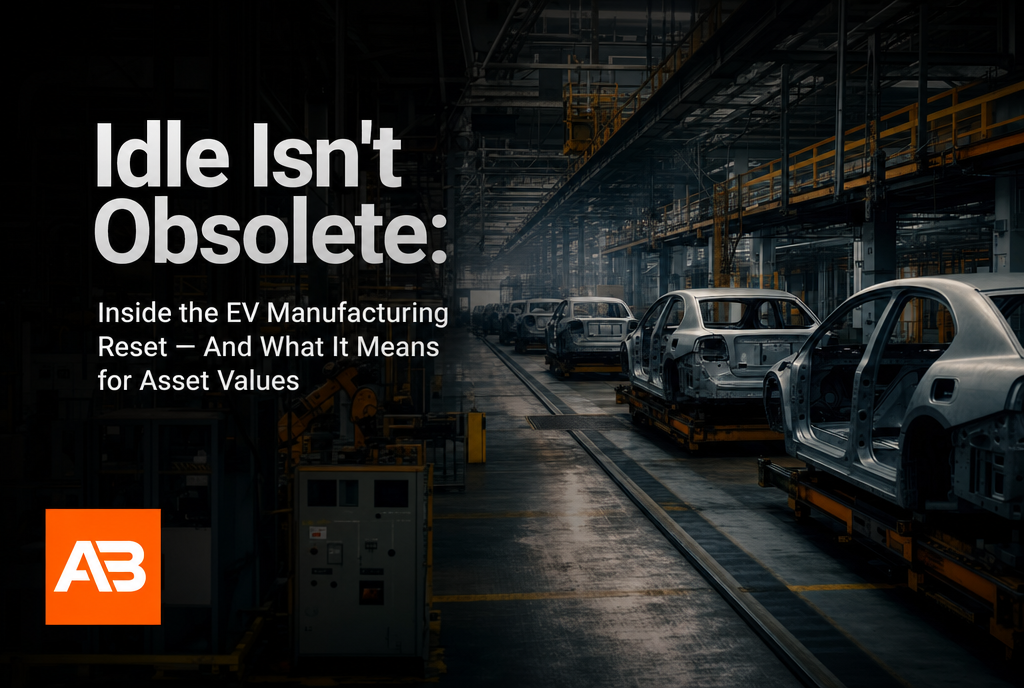
The headline version of the EV story is a collapse. The real version is a reallocation — and for anyone holding industrial assets, the difference is worth millions.
The numbers look grim in isolation. Since 2022, roughly $18.3 billion in announced EV manufacturing investment has been canceled, according to Atlas Public Policy, with medium- and heavy-duty electric vehicle sales falling nearly 32% year over year in the first half of 2026. A Reuters analysis of the same data found close to $20 billion in U.S. EV-related manufacturing projects canceled in 2025 alone. The Dallas Federal Reserve notes that many plants still under construction have seen start dates pushed out, with their ultimate fate unresolved heading through 2026.
But cancellation is only one of three things happening at once — and the other two are where value actually moves.
Across the battery corridor, projects are being canceled, delayed, downsized, or converted to entirely different uses. Converted is the operative word.
Capacity originally engineered for automotive cells is being re-aimed at grid-scale energy storage. The demand signal driving it is real: while EV sales underperformed expectations, lithium-ion demand for battery energy storage systems has grown rapidly and is expected to stay strong through 2026, driven by data center load growth, utility-scale renewables integration, and grid stability requirements.
The economics are straightforward. The electron storage market needs capacity now. The vehicle market needs it later, and less of it than anyone projected. Capital follows the shorter timeline.
Here's the part the headlines miss. The most disciplined operators in this sector aren't waiting for distress to reassess their capital position. They're doing it while the lights are on.
When a company builds out for one demand curve and the curve moves, the result isn't always a shuttered plant. Often it's a warehouse of equipment that was ordered, paid for, delivered — and overtaken by a revised plan before it was ever energized. That equipment isn't damaged, outdated, or underperforming. It's simply no longer matched to the mission.
Which is exactly the situation behind two sales we're bringing to market next month.
AssetBuilt has been retained to conduct a two-part global offering of assets surplus to the ongoing operations of R3 Lithium, a battery recycling and critical energy materials producer. R3 continues to operate. What's being sold is the gap between an original capital plan and a recalibrated one — and the composition of that gap tells you everything about where this market is heading.
Day 1 — Hopkinsville, Kentucky | October 13, 2026, 10:00 AM (webcast)
The offering is anchored by new, unused high-capacity industrial transformers, still crated in OEM packaging, alongside heavy-duty switchgear line-ups, motor control centers, severe-duty high-horsepower motors, centrifugal slurry and process pumping packages, high-alloy control valves, factory-boxed instrumentation, and a substantial unissued MRO storehouse. The majority of the portfolio is brand-new and uninstalled.
The significance sits in one number: OEM lead times for high-demand power and chemical equipment currently run 50 to 80+ weeks. Anyone who has tried to procure a large transformer for a data center build, a utility interconnect, or a greenfield expansion knows that queue is the binding constraint on the entire project. This equipment is available now.
Day 2 — Covington, Georgia | October 21, 2026, 10:00 AM (webcast)
Day 2 goes deep on chemical synthesis and materials processing, headlined by a complete pCAM (precursor cathode active material) production line and a fully integrated industrial water filtration line installed new in 2023 and never brought into commercial production.
The line includes jacketed CSTRs in 316L stainless, Hastelloy, and glass-lined construction with automated pH/ORP control and nitrogen blanketing; dissolution and feed preparation for nickel, cobalt, and manganese sulfate; filter presses, decanter and peeler centrifuges, and DI cake washing; drying, air classification, sieving, and magnetic separation; ammonia stripping columns; a sodium sulfate evaporator and crystallization package; continuous effluent neutralization with heavy-metal precipitation; complete DCS/PLC automation with intelligent MCCs and VFDs; and a full analytical QC lab including SEM, ICP-OES/ICP-MS, and laser diffraction particle-size analysis.
Owners hesitate to bring battery-adjacent assets to market because they assume a soft EV cycle means soft demand for EV-adjacent equipment. The evidence points hard in the other direction.
Trade policy has stayed unsettled — a February 2026 Supreme Court ruling struck down emergency-based tariffs, followed immediately by a new tariff under Section 122 — keeping new-equipment pricing under pressure. Combine that with long OEM queues, uneven parts availability, and elevated freight and financing costs, and the secondary market has stopped being a fallback. Many plant managers now treat it as a primary acquisition strategy, and the market rewards sellers whose equipment is clean, documented, and realistically priced.
More to the point, most of this equipment was never EV-specific at its core. Power distribution, precision automation, hydrometallurgical process trains, water treatment and ZLD systems, and high-purity materials handling all transfer cleanly. The R3 assets are being marketed directly into hyperscale data centers and critical power infrastructure, electric utilities and independent power producers, chemical and petrochemical processing, critical minerals and hydrometallurgical refining, pharmaceutical intermediates, industrial water and effluent treatment, and EPC contractors running greenfield builds.
That's the reallocation in one sentence: capital deployed for the battery build-out is being redeployed into the power and process build-out. The buyer is frequently in a different industry entirely — which is precisely why global reach determines recovery.
Inventory before you decide. A strategy built on an outdated fixed-asset register produces the wrong answer. Verified nameplate-level detail is the foundation of every valuation that follows.
Separate the four outcomes deliberately. Redeployment, targeted private sale, auction, and scrap each fit a different asset profile. Applying one method across an entire facility leaves money on the floor.
Treat timing as a variable you control. Carrying costs, environmental exposure, and technology drift compound. Equipment that would have cleared well twelve months ago rarely clears better twelve months from now — and the lead-time premium buyers are paying today is the strongest tailwind sellers have had in years.
Don't wait for distress. The cleanest recoveries in this market come from operating companies making deliberate decisions early, not from forced processes on a court's timeline.
The battery build-out isn't disappearing. It's being rewritten — and rewriting an industrial map means moving an extraordinary amount of physical capital from where it was placed to where it's now needed. For owners, lenders, restructuring professionals, and private equity holders, the question is no longer whether these assets move. It's whether they move with a strategy behind them.
The R3 Lithium surplus offering is open for global online bidding.
Day 1 — Hopkinsville, KY | October 13, 2026, 10:00 AM
Day 2 — Covington, GA | October 21, 2026, 10:00 AM
Inspection by appointment. Register to bid →
AssetBuilt advises manufacturers, lenders, and investors on industrial asset valuation, recovery, and disposition — including EV, battery, critical minerals, and energy storage facilities. Built for what's next.