
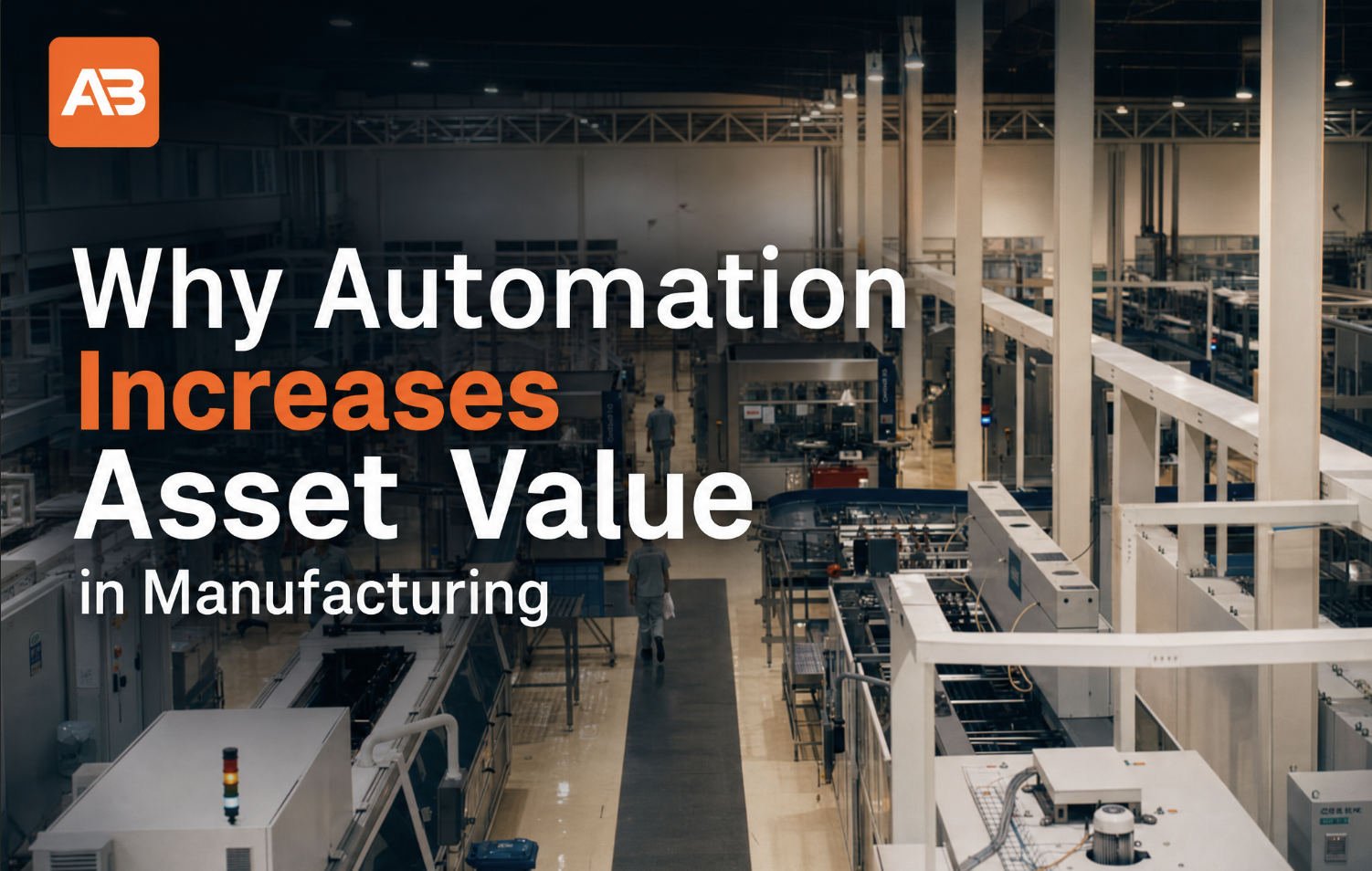
Automation is defined as the deployment of technology to execute processes with reduced human intervention, and it increases asset value by raising net operating income (NOI) while lowering operational risk. For corporate finance executives and operations managers, understanding why automation increases asset value is not a theoretical exercise. It is a direct input to capitalization rate calculations, debt-service coverage ratios, and exit pricing. Smart building platforms reduce operating expenses by 15% through predictive maintenance and energy optimization, translating directly into higher NOI and asset valuation. The industry has shifted from viewing automation as a depreciating technology expense to recognizing it as a persistent margin driver and valuation lever.
Automation reduces operating costs through two primary mechanisms: predictive maintenance and energy optimization. Both translate directly into higher NOI, which is the numerator in any capitalization rate valuation. A higher NOI at the same cap rate produces a proportionally higher asset value.
Predictive maintenance extends mechanical asset lifecycles by 20–40% by identifying failure signals before breakdowns occur. That extension defers capital expenditure on equipment replacement, which directly improves free cash flow and net asset value. For a manufacturing facility running continuous production lines, avoiding a single unplanned shutdown can preserve weeks of output.

Energy optimization compounds the benefit. Automated systems adjust HVAC, lighting, and power loads in real time based on occupancy and production schedules. The result is a measurable reduction in utility costs without any reduction in output capacity.
| Cost Driver | Manual Process | Automated Process |
|---|---|---|
| Equipment maintenance | Reactive repair after failure | Predictive alerts before failure |
| Energy consumption | Fixed schedules, manual adjustments | Real-time load optimization |
| Operating expense impact | Higher, variable costs | Lower, predictable costs |
| Asset lifecycle | Standard manufacturer timeline | Extended by 20–40% |
Pro Tip: Map your facility’s top five energy and maintenance cost lines before deploying automation. Targeting those specific lines first produces the fastest NOI improvement and the clearest valuation case for lenders and buyers.
Labor is the largest variable cost in most manufacturing operations. Automation reduces the number of full-time equivalents required for routine monitoring, coordination, and reporting tasks. That reduction flows directly into NOI.

A concrete example illustrates the scale. Automation enables $4,000 monthly payroll reductions in specialized assets, translating to $48,000 in annual NOI improvement. On a $3.5 million SBA-financed project, that improvement produces a material uplift in the Debt-Service Coverage Ratio (DSCR). DSCR is the ratio of NOI to annual debt service. Lenders use it to determine loan approval and terms.
The quantitative relationship is direct. Every 100 basis points of margin retained through automation yields a 0.10x–0.25x DSCR uplift on typical SBA-financed projects. That uplift is the difference between a loan approval and a decline, or between standard terms and favorable ones.
Finance executives should present automation investments in financial memos using the following framework:
This four-step framing shifts the conversation from “we spent money on technology” to “we improved the asset’s income profile permanently.”
Buyers price uncertainty aggressively. Lowering perceived operational risk through automation directly elevates asset valuations and deal attractiveness. This is the qualitative dimension of automation’s value, and it is as financially significant as the NOI improvement.
Automation signals three things to a prospective buyer:
“Buyers value automation because it lowers operational risks, improves predictability, and reduces dependency on owners. Embedded automation that simplifies operations increases valuation premium, while last-minute implementations are discounted.”
Early, embedded automation increases buyer confidence by demonstrating operational independence. Late-stage automation, added in the six months before a sale, is treated with skepticism. Buyers assume it has not been tested under real operating conditions and discount it accordingly. Operations managers who embed automation early in the ownership cycle capture the full valuation benefit at exit.
Automation’s value extends beyond back-of-house cost reduction. When integrated into customer-facing services, sustainability reporting, and predictive service delivery, automation builds equity that commands valuation premiums at exit.
Automation-integrated assets in hospitality achieve valuation premiums of 60–120 basis points on exit compared to non-integrated assets. The same principle applies in manufacturing, where automation that supports ESG compliance reporting, quality control traceability, and supply chain visibility adds a layer of institutional attractiveness that pure cost-reduction programs cannot replicate.
| Automation Layer | Back-of-House Benefit | Front-of-House or Institutional Benefit |
|---|---|---|
| Predictive maintenance | Lower repair costs | Demonstrated reliability for buyers and lenders |
| Energy management | Reduced utility expense | ESG compliance data for institutional investors |
| Workflow automation | Fewer labor hours | Scalable operations attractive in M&A due diligence |
| Quality control automation | Reduced defect rates | Audit-ready traceability for regulatory compliance |
Front-of-house automation integration builds real equity and acquisition desirability beyond back-of-house efficiency gains. For operations managers, this means automation investments should be evaluated not only on their cost-reduction payback but on their contribution to the asset’s market positioning and exit narrative.
Pro Tip: Document every automation system’s output data, including uptime logs, energy savings reports, and maintenance records. That documentation becomes a due diligence asset that supports your valuation claims during a sale or refinancing.
Automation in asset management also supports internal rate of return (IRR) stability during ownership transitions and brand conversions. When a manufacturing facility changes ownership or undergoes a brand conversion, automated systems reduce the operational disruption that typically compresses returns during transition periods. That stability is a concrete financial benefit that sophisticated buyers recognize and price into their offers.
Automation increases asset value by improving NOI, extending asset lifecycles, reducing operational risk, and signaling scalability to buyers and lenders.
| Point | Details |
|---|---|
| NOI is the core mechanism | Automation reduces operating costs, which raises NOI and directly increases asset valuation at any given cap rate. |
| DSCR uplift is quantifiable | Every 100 basis points of margin retained through automation yields a 0.10x–0.25x DSCR improvement on SBA-financed projects. |
| Early integration captures full value | Automation embedded early in the ownership cycle commands full valuation premiums; late-stage additions are discounted by buyers. |
| Labor reduction drives annual NOI gains | A $4,000 monthly payroll reduction translates to $48,000 in annual NOI improvement, a material figure in any financing model. |
| Automation signals scalability to buyers | Buyers pay premiums for assets with repeatable, owner-independent operations that can scale without proportional cost increases. |
I have reviewed enough asset transactions to identify a consistent error in how finance teams present automation investments. They frame automation as a capital expenditure with a payback period. That framing is factually accurate but strategically wrong.
When you present automation as a cost with a three-year payback, you invite scrutiny of the upfront spend. When you present it as a margin-retention mechanism that permanently improves NOI, you shift the conversation to asset value. Those are two entirely different conversations, and only one of them increases your valuation.
The shift from ROI to NOI thinking is not semantic. It changes how lenders underwrite the asset, how buyers model their returns, and how appraisers justify their conclusions. Finance executives who make this shift early gain a structural advantage in every financing and exit conversation.
The second error I see is timing. Operations managers often propose automation as a pre-sale improvement. That instinct is correct, but the execution is usually too late. Substantial financial benefits from automation emerge when applied to high-volume, variable workflows over time, not in a compressed pre-sale window. The data trail that automation produces, including uptime records, cost reduction logs, and maintenance histories, is what convinces buyers and lenders. That trail takes time to build.
My practical advice: treat automation as a core capital services decision made at acquisition or early in the ownership cycle, not as a cosmetic improvement made at exit. The assets that command the highest valuations are the ones where automation is indistinguishable from the operation itself.
— Jake Freedlander
Assetbuilt operates across the full lifecycle of complex industrial asset transactions, from advisory and capital alignment through final execution. For finance executives and operations managers evaluating automation-enhanced manufacturing assets, that full-lifecycle coverage matters.
Assetbuilt’s business advisory services include valuation analysis that accounts for automation-driven NOI improvements, DSCR modeling, and exit positioning. Current auction inventory includes the automotive manufacturing equipment facility sale, which features automated production equipment with documented operational histories. Assetbuilt also recently handled the disposition of former EV manufacturer assets, including Dürr adhesive systems and automation MRO equipment, demonstrating direct experience with the automated manufacturing asset class. Finance and operations leaders seeking to maximize value through automation can engage Assetbuilt at any stage of the asset lifecycle.
Automation increases NOI by reducing operating expenses and labor costs. Higher NOI produces a higher asset valuation at any given capitalization rate.
Every 100 basis points of margin retained through automation yields a 0.10x–0.25x DSCR uplift on typical SBA-financed projects, which directly improves loan approval prospects and financing terms.
Automation should be embedded early in the ownership cycle. Late-stage implementations are discounted by buyers because they lack the operational track record that supports full valuation premiums.
Buyers price operational uncertainty into their offers. Automation reduces that uncertainty by demonstrating repeatable processes, owner independence, and scalability, all of which lower the risk premium buyers apply.
Automation-integrated assets in hospitality achieve valuation premiums of 60–120 basis points on exit compared to non-integrated assets. The same premium logic applies in manufacturing when automation supports ESG compliance, quality traceability, and scalable workflows.