

Industrial portfolio liquidity planning is the process by which financial executives manage asset convertibility and cash availability to protect enterprise value across industrial holdings. The industry term for this discipline is portfolio liquidity management, and it encompasses asset disposition, financing structure, and scenario governance. A structured portfolio overhaul can increase ROIC by over 600 basis points and restore liquidity headroom above safety thresholds within 12 months. That result is not accidental. It follows a repeatable framework built on segmentation, valuation discipline, and capital sequencing. This guide delivers that framework for financial executives and asset managers operating in industrial sectors.
Effective liquidity planning starts before any asset moves. Financial executives who skip the foundation stage consistently encounter valuation disputes, inaccurate borrowing base calculations, and delayed dispositions.
Portfolio segmentation is the first requirement. Assets must be sorted by value tier, urgency, and type before any disposition or financing decision is made. Without segmentation, capital allocation defaults to gut instinct rather than data. High-value production equipment, mid-tier tooling, and obsolete inventory each require a different exit path and timeline.

Unified valuation definitions are equally non-negotiable. Valuation playbooks standardize definitions of Fair Market Value (FMV), Orderly Liquidation Value (OLV), and Forced Liquidation Value (FLV) across all portfolio units. Without this consistency, different business units report different collateral values for the same asset class, which breaks borrowing base calculations and creates audit exposure.
Carrying cost visibility is the third prerequisite. Storage costs for idle industrial equipment average $6.50 per square foot per month. That figure compounds fast across large facilities. Financial executives must map every idle asset against its monthly carrying cost to identify which positions are actively destroying value.
The final prerequisite is establishing minimum liquidity thresholds and breach protocols. Scenario analysis frameworks codify these thresholds in advance so teams respond to stress signals with pre-approved actions rather than improvised decisions.
Pro Tip: Track spindle hours and cycle times rather than chronological age when estimating liquidable value for industrial equipment. Age-based depreciation consistently overstates collateral value for lightly used assets and understates it for high-cycle machines.
A repeatable execution framework separates portfolios that recover liquidity from those that erode it. The following sequence applies across manufacturing, logistics, and energy-intensive industrial holdings.
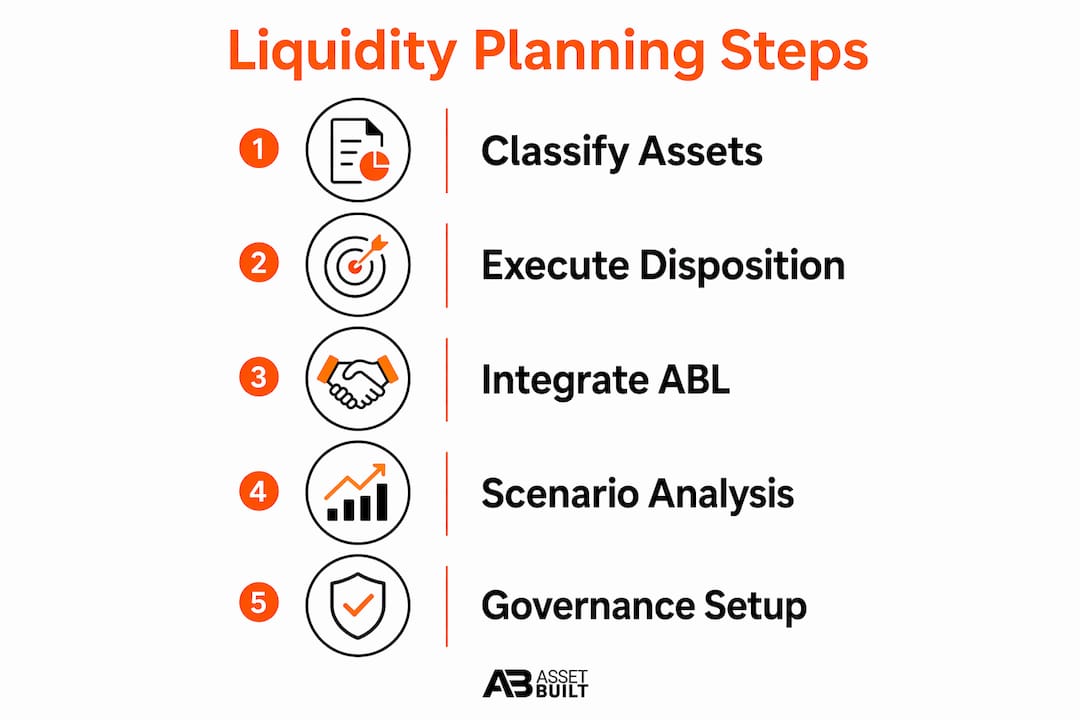
Asset classification determines the exit method and timeline for every position in the portfolio. Segmenting inventory by value and urgency produces three distinct disposition tracks.
Asset TierDisposition MethodTypical TimelineHigh-value production equipmentPrivate sale90–180+ daysMid-value tooling and machineryAuction45–90 daysObsolete or end-of-life assetsScrap or parts sale7–30 days
This classification prevents financial executives from routing high-value assets through auctions prematurely, which destroys recovery value. It also prevents obsolete inventory from sitting in storage for months while carrying costs accumulate.
Once classified, underutilized and end-of-life equipment must move. Delayed disposition is one of the most common and costly errors in portfolio liquidity management. Every month an idle asset sits in a facility, it consumes floor space, insurance, and maintenance budget without generating return.
Disposition is not limited to outright sale. Mission-critical production assets that represent 70–80% of industrial bases frequently qualify for sale-leaseback arrangements. This approach converts owned assets into immediate cash while preserving operational continuity. Financial executives often overlook this option because the assets appear indispensable. The key question is not whether the asset is critical but whether owning it outright is the most capital-efficient structure.
Asset-based lending (ABL) ties borrowing capacity directly to the liquidation value of receivables, inventory, and equipment. ABL facilities can maintain 2–3x liquidity compared to EBITDA-based revolvers at downturn troughs. That difference is material when cash-flow-based covenants tighten precisely when liquidity is most needed.
ABL facilities also introduce financial discipline through reserve requirements and springing covenants. These mechanisms tie borrowing availability dynamically to asset quality, which forces ongoing attention to collateral health. Financial executives who integrate ABL alongside cash-flow facilities maximize total borrowing capacity while maintaining operational flexibility. Assetbuilt’s capital services support this integration across complex industrial portfolios.
Scenario analysis is not a forecasting exercise. It is a governance tool that defines how the portfolio responds to specific stress conditions before those conditions occur. Portfolios without scenario discipline react late. Portfolios with it act on pre-approved protocols.
The scenario architecture should cover at least three conditions: a base case, a demand contraction scenario, and a commodity price shock scenario. Each scenario maps to a specific capital deployment sequence and a defined breach response. This structure prevents ad hoc decisions during stress periods, which typically destroy more value than the stress event itself.
Pro Tip: Assign a named owner to each breach protocol within the scenario framework. Liquidity governance fails most often not because the protocol is wrong but because no one has clear authority to trigger it.
Liquidity metrics require continuous monitoring, not quarterly review. Financial executives should track borrowing base utilization, carrying cost per idle asset, and disposition pipeline velocity on a monthly basis at minimum. Governance mechanisms must include escalation paths that activate automatically when metrics breach defined thresholds.
Execution failures in portfolio liquidity management follow predictable patterns. Recognizing them in advance reduces both the frequency and the cost of each error.
The secondary market for industrial equipment is changing faster than most financial executives realize. Three structural shifts are redefining what is possible in ongoing liquidity management.
Digitization of secondary markets is improving pricing transparency and transaction speed. AI-powered valuations and provenance verification are entering the industrial secondary market, reducing the information asymmetry that historically suppressed recovery values. Financial executives who engage these platforms earlier in the disposition process capture better pricing.
AI-driven valuation models are improving planning precision. These models incorporate use metrics, market transaction data, and condition reports to produce liquidable value estimates that are more accurate than traditional appraisal methods. The practical implication is that borrowing base calculations and disposition timing decisions can be made with higher confidence.
Sale-leaseback adoption is growing among institutional industrial owners. This financing structure unlocks capital from owned real estate and production assets without disrupting operations. Financial executives who have not evaluated their owned asset base for sale-leaseback potential are leaving capital efficiency on the table.
“Industrial portfolios can unlock hidden capital through underutilized mission-critical production assets using financing structures like sale-leaseback. The assets do not need to be idle to generate liquidity. They need to be evaluated honestly against the cost of ownership.”
ESG and audit reporting are also becoming liquidity planning inputs. Asset lifecycle data collected for ESG disclosures provides a ready-made source of condition and utilization information that can inform disposition timing and collateral valuation. Financial executives who integrate ESG data into their valuation playbooks gain a secondary benefit from reporting obligations they already carry.
Continuous scenario analysis refinement aligned with macroeconomic conditions rounds out the best practice set. Scenarios built in 2024 do not reflect 2026 supply chain conditions, interest rate levels, or commodity price dynamics. Annual scenario updates are a minimum standard. Quarterly updates are preferable for portfolios with high cyclical exposure.
Effective industrial portfolio liquidity management requires segmentation, valuation discipline, and pre-built governance protocols that activate before stress events occur.
PointDetailsSegment before you actClassify all assets by value tier and urgency before selecting a disposition method or financing tool.Standardize valuationsAlign FMV, OLV, and FLV definitions across all units to prevent borrowing base errors and audit exposure.Use ABL alongside cash-flow facilitiesABL can maintain 2–3x more liquidity than EBITDA-based revolvers during cyclical downturns.Build breach protocols in advancePre-approved triggers prevent reactive decision-making when liquidity stress actually arrives.Monitor secondary market digitizationAI-driven valuations and online disposition platforms are improving recovery values for industrial equipment.
I have worked through enough industrial portfolio reviews to say this plainly: the gap between portfolios that manage liquidity well and those that do not is almost never analytical. The analysis is usually sound. The gap is in codification.
Financial executives know they should set liquidity thresholds. Very few have written them down, assigned ownership, and tied them to automatic breach responses calibrated for industrial cyclicality. When a downturn arrives, the portfolio that has done this work acts in the first week. The portfolio that has not spends the first month in meetings.
The same pattern holds for asset-based lending. I have seen industrial companies carry significant idle equipment on their balance sheets while drawing on expensive revolving credit. The ABL facility that could have been structured against that equipment was never pursued because it required a valuation exercise that felt like extra work during good times. During bad times, it felt like a missed opportunity.
Portfolio simplification deserves more attention than it typically gets. Executives focus on adding liquidity tools. Fewer focus on reducing the number of asset categories that require active management. A simpler portfolio is easier to segment, easier to value, and easier to finance. Complexity is a liquidity cost that rarely appears on any report.
The digitization of secondary markets is real and accelerating. Financial executives who treat asset disposition as a one-time event are already behind. The platforms and AI valuation tools entering this space will reward those who engage them as ongoing channels rather than emergency exits.
Assetbuilt operates across the full lifecycle of complex industrial asset transactions, from advisory and capital alignment through final execution. For financial executives managing disposition timelines, Assetbuilt runs structured industrial equipment auctions that match asset tier to the right buyer channel, whether private sale, competitive auction, or negotiated transaction.
On the capital side, Assetbuilt’s asset-based lending advisory helps industrial portfolios structure facilities against receivables, inventory, and equipment to maximize borrowing capacity without depending on EBITDA performance. Financial executives who want to see recent execution results can review past auction outcomes and press releases directly on the Assetbuilt platform. The firm’s track record spans automotive manufacturing, logistics fleet liquidation, and advanced manufacturing equipment, covering the asset categories where liquidity planning decisions carry the highest stakes.
Industrial portfolio liquidity planning is the process of managing asset convertibility, financing structure, and cash availability across industrial holdings to protect enterprise value. It combines asset disposition, valuation discipline, and scenario-based governance into a repeatable framework.
Industrial assets are illiquid because they are specialized, physically fixed, and require qualified buyers with specific operational needs. Thin secondary markets and high transaction costs extend disposition timelines to 45–180+ days depending on asset type.
Asset-based lending ties borrowing capacity to the liquidation value of receivables, inventory, and equipment rather than to earnings. ABL facilities can maintain 2–3x more liquidity than EBITDA-based revolvers during cyclical downturns, making them a critical tool for industrial portfolios.
Scenario analysis codifies minimum liquidity thresholds and breach protocols in advance, so portfolios respond to stress with pre-approved actions rather than improvised decisions. Portfolios with scenario discipline preserve more enterprise value during downturns than those without it.
Classifying idle assets by value tier and moving obsolete equipment to scrap or parts channels within 7–30 days produces the fastest liquidity improvement. Eliminating carrying costs on non-performing assets frees cash without requiring new financing or asset sales at distressed values.