

A debt repayment asset liquidation strategy is a structured process of converting company assets into cash specifically to repay outstanding debts and restore financial stability. For distressed companies, this process, formally known as corporate deleveraging through asset divestiture, determines whether a business survives restructuring or faces court-mandated dissolution. The strategy requires systematic asset identification, rigorous cost-benefit analysis, and precise legal compliance. Executives who execute it proactively recover more value than those who wait for creditors or courts to force the issue.
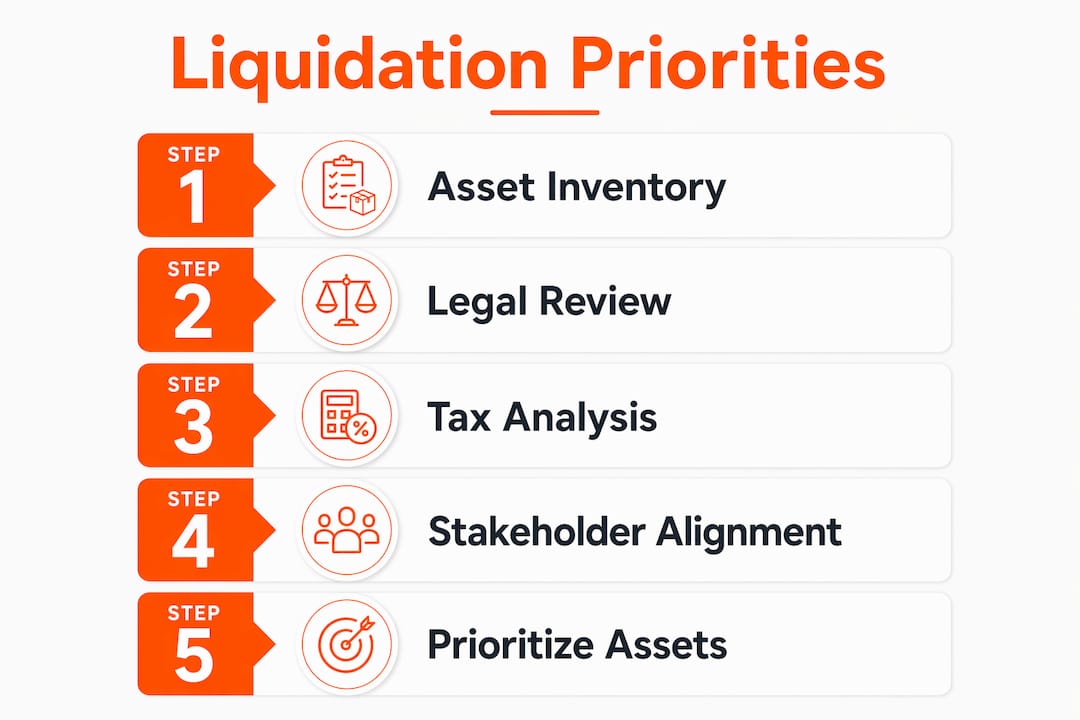
Every effective liquidation plan starts with a complete, verified asset inventory. Without one, executives cannot distinguish core assets from non-core ones, and they cannot accurately assess recovery potential against disposal costs. The inventory must capture book value, estimated market value, encumbrances, and physical condition for every asset class, from capital equipment to real estate to intellectual property.
Legal review is the second non-negotiable prerequisite. Directors can face personal liability if creditor notifications are mishandled or statutory timelines are missed. State exemption thresholds, lien priorities, and notification requirements vary significantly, so engaging qualified legal counsel before any sale is executed protects the company and its officers.

Tax exposure deserves equal attention. Every asset sale is a taxable event generating capital gains or losses with IRS reporting requirements. The tax rate depends on asset type and holding period, so accounting teams must model the after-tax proceeds for each asset before committing to a sale sequence.
Stakeholder engagement completes the preparation phase. Creditors, board members, and key operational staff all need clear communication about the plan’s scope and timeline. Early creditor engagement reduces the risk of contested sales and creates room for negotiated workout agreements.
Pro Tip: Build a two-column asset register that pairs each asset’s estimated net recovery value (market value minus disposal costs and taxes) against the specific debt tranche it will retire. This single document becomes the decision-making anchor for the entire process.
Asset prioritization is where most distressed companies lose value. The instinct is to sell whatever is easiest to sell first. The correct approach is to sell whatever generates the highest net recovery against the most expensive debt first.
Financial strategists recommend identifying the internal cost of capital for each debt tranche before selecting assets for sale. A secured term loan at 14% interest costs the company far more per day than a subordinated note at 6%. Retiring the most restrictive and expensive debt first reduces the total cost of the restructuring, even if the assets sold to do so are harder to move.
The core versus non-core distinction is equally critical. Core assets generate the revenue that will service remaining debt after restructuring. Selling them to retire cheap debt destroys future cash flow. Non-core assets, including idle equipment, surplus real estate, and underperforming subsidiaries, are the correct first candidates for any asset liquidation for debt relief program.
Bankruptcy trustees apply the same logic: they abandon assets when liquidation costs exceed recovery potential. Executives in out-of-court restructurings should apply the same discipline. Not every asset on the balance sheet is worth selling.
The following criteria form a practical prioritization framework:
Pro Tip: Run a sensitivity analysis on each asset’s net recovery value using three scenarios: orderly sale, accelerated sale, and distressed auction. The gap between orderly and distressed pricing is often 30–50%, which quantifies the cost of delay for board presentations.
Execution requires a defined sequence. Deviating from it creates legal exposure and destroys creditor confidence.
More than 70% of Chapter 7 bankruptcy cases are no-asset cases where assets are exempt or liquidation costs outweigh recoveries. This figure illustrates how often distressed companies reach formal insolvency with little left to distribute. Executives who act before that point preserve far more value for all stakeholders.
Maintaining operational continuity during asset disposals is the central execution risk. Selling a manufacturing line or a logistics fleet while the business continues operating requires careful sequencing. Assets scheduled for sale must be isolated from active production workflows before marketing begins, and replacement arrangements, whether leased equipment or outsourced services, must be in place before the sale closes.
Creditor negotiation does not end when the liquidation plan is approved. Structured settlements and workout agreements can extend payment timelines in exchange for partial debt forgiveness, reducing the total asset base that must be sold. Executives who treat creditor communication as an ongoing process rather than a one-time notification consistently achieve better outcomes.
Post-liquidation financial monitoring requires the same rigor as the liquidation itself. Leverage ratios, interest coverage, and free cash flow must be tracked against the restructured debt schedule monthly. Deviations signal the need for additional divestitures or renegotiation before they become defaults.
Proactive deleveraging executed through strategic divestments signals resilient stewardship and protects long-term enterprise value. Waiting for involuntary liquidation compresses sale timelines and lowers asset prices compared to orderly, planned sales.
Risk mitigation across the process requires attention to four specific exposures:
Assetbuilt’s capital services practice addresses each of these risk categories within a single advisory engagement, from initial asset valuation through final proceeds distribution.
Maintaining operational continuity during asset disposals is the central execution risk. Selling a manufacturing line or a logistics fleet while the business continues operating requires careful sequencing. Assets scheduled for sale must be isolated from active production workflows before marketing begins, and replacement arrangements—whether leased equipment or outsourced services—must be in place before the sale closes.
Risk mitigation across this process requires specialized attention to four distinct operational exposures:
Managing these moving parts internally often strains a distressed corporate team. This is where partnering with a full-cycle advisory firm like Assetbuilt protects enterprise value. By integrating legal, financial, and operational coordination into a single workflow, Assetbuilt eliminates the coordination gaps that typically erode net proceeds between the first asset assessment and final distribution.
For example, when an orderly private sale isn't fast enough to satisfy tight creditor timelines, leveraging an established industrial auction platform becomes necessary. In recent restructurings—including the divestiture of assets for a battery pack cell manufacturer and a major automotive equipment facility—Assetbuilt structured the asset lots to maximize competitive cross-border bidding. This global reach ensures that even compressed timeline sales achieve true market value, transforming a forced liquidation into an optimized capital allocation event.
A debt repayment asset liquidation strategy is ultimately not a declaration of insolvency; it is an aggressive, calculated rebalancing of the balance sheet. The boundary between a chaotic corporate collapse and a successful financial restructuring depends entirely on leadership's willingness to act before the choice is taken out of their hands.
By systematically identifying non-core assets, ruthlessly prioritizing the highest-cost debt tranches, and maintaining airtight compliance, executives can steer their companies through periods of severe distress while keeping operational engines intact. Protecting enterprise value requires discarding the misconception that divestiture is a sign of weakness. In the modern corporate landscape, proactive deleveraging is the ultimate indicator of resilient stewardship and decisive leadership.
With the right framework in place—and the right operational partners to secure global market value for your assets—what begins as a defensive debt crisis can be transformed into a streamlined, high-performance chapter for the enterprise.
A debt repayment asset liquidation strategy is a structured process of converting company assets into cash to retire outstanding debts and restore financial stability. It combines asset valuation, legal compliance, and creditor negotiation into a sequenced execution plan.
Executives should prioritize non-core assets with the highest net recovery value that can retire the most expensive or restrictive debt tranches first. Core revenue-generating assets should be protected unless all other options are exhausted.
The primary methods are auctions, private treaty sales, sale-leaseback arrangements, and debt-for-equity swaps. Auction commissions range 15–35% of gross proceeds, so private sales preserve more net value when a qualified buyer can be identified quickly.
Proactive deleveraging through planned divestitures preserves more value because it allows orderly marketing and competitive pricing. Court-mandated liquidation compresses timelines and typically produces lower asset prices due to forced-sale conditions.
Every asset sale during liquidation is a taxable event subject to IRS reporting. Proceeds are taxed at ordinary income or capital gains rates depending on asset type and holding period, making pre-sale tax modeling a required step in any liquidation plan.