Discover the complex asset lifecycle explained for manufacturing leaders. Learn how to optimize each stage for better ROI and operational efficiency.

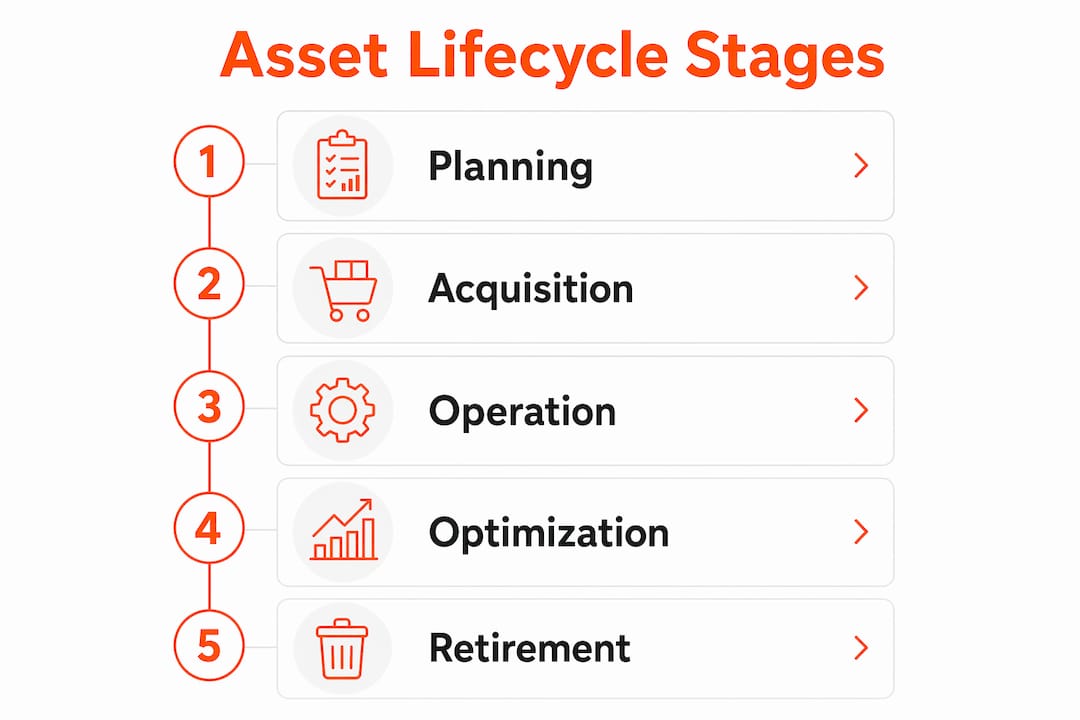
The complex asset lifecycle is defined as the complete sequence of stages a physical industrial asset passes through, from initial planning and capital commitment to final disposal or retirement. Industry frameworks recognize five core stages: Planning and Strategy, Acquisition and Commissioning, Operation and Maintenance, Performance Optimization, and Retirement and Disposal. For financial executives and operations managers in manufacturing, understanding asset lifecycles is not a maintenance exercise. It is a capital discipline that directly shapes depreciation schedules, operational uptime, and long-term return on investment. Getting it right requires structured data, cross-functional alignment, and decisions grounded in performance evidence rather than arbitrary timelines.
The complex asset lifecycle explained in practical terms means knowing what decisions belong to each stage and who owns them. Each stage has distinct activities, data requirements, and financial consequences.
StageMain activitiesPrimary ownerKey data needsPlanning and StrategyNeeds assessment, digital twin modeling, capital budgetingFinance, EngineeringDemand forecasts, performance benchmarksAcquisition and CommissioningProcurement, integration, commissioning testsOperations, ProcurementVendor specs, compatibility dataOperation and MaintenanceScheduled maintenance, work orders, condition monitoringMaintenance, OperationsMaintenance history, failure recordsPerformance OptimizationData analytics, condition-based upgrades, reliability reviewsEngineering, FinanceReal-time performance, cost-per-unit dataRetirement and DisposalDecommissioning, residual value recovery, asset write-offFinance, OperationsBook value, market value, regulatory requirements

The Planning and Strategy stage sets the financial ceiling for every stage that follows. Digital twins simulate asset performance under real operating conditions before any capital is committed. That simulation reduces the risk of acquiring equipment that becomes obsolete or misaligned with production requirements within a few years.
Acquisition and Commissioning is where procurement decisions lock in future costs. Prioritizing asset fit and data integration over initial purchase price is the defining factor for long-term success. An asset that integrates cleanly with existing maintenance systems costs far less to operate than a cheaper asset that requires manual data entry and workarounds.
Operation and Maintenance is the longest and most resource-intensive stage. It consumes the largest share of total lifecycle spending across most manufacturing environments. Condition monitoring, work order management, and maintenance history records are the operational backbone of this phase.
Performance Optimization sits between active operation and end-of-life planning. This stage uses condition, performance history, and total cost of ownership data to determine whether an asset should be maintained, upgraded, or retired. Decisions made here prevent both premature replacement and costly failure.
Retirement and Disposal closes the lifecycle. Proactive decommissioning recovers residual value and corrects the financial record. Skipping this stage creates phantom assets, which inflate liabilities and distort capital planning.
Pro Tip: Assign a named owner to each lifecycle stage in your asset register. Ownership gaps between stages are where data loss and cost overruns consistently occur.
Asset lifecycle management (ALM) is the recognized industry term for the structured process of managing assets across all five stages. The complex asset management process fails most often not because of bad equipment, but because finance, operations, and maintenance teams operate from separate data sets.
Integrating ALM with Enterprise Asset Management (EAM) creates a single source of truth for asset condition, maintenance history, and capital status. That shared data environment eliminates the gap between what the finance team believes an asset is worth and what the maintenance team knows about its actual condition. The result is fewer emergency repairs, less unplanned downtime, and more accurate capital allocation.
The shift from reactive to proactive maintenance is the most measurable benefit of ALM integration. Reactive maintenance responds to failures after they occur. Proactive maintenance uses condition monitoring data to schedule interventions before failure, reducing both repair costs and lost production time.
Key benefits of an integrated ALM approach include:
Pro Tip: Start ALM integration by pulling maintenance history and real-time performance data into your existing ERP or EAM platform before evaluating new software. Incremental integration delivers results faster and with less organizational disruption than a full platform replacement.
The most financially damaging pitfall in complex asset lifecycle management is the phantom asset. Phantom assets are non-operational assets still carried on the books. They inflate depreciation charges, increase insurance premiums, and distort tax calculations. Most financial executives encounter phantom assets during audits rather than through proactive management, which means the financial damage has already accumulated.
The second major pitfall is treating the lifecycle as a straight line. Most asset lifecycles in complex environments are nonlinear. Mid-life refurbishments, repurposing, and partial upgrades often deliver better return on investment than full replacement. A CNC machining center that receives a controls upgrade at year eight may deliver another decade of productive life at a fraction of replacement cost.
Arbitrary depreciation schedules are not lifecycle management. Using condition, performance history, residual value, and total cost of ownership data to decide when to maintain, repair, replace, or retire an asset prevents the costly mistakes that fixed timelines produce.
A third pitfall is underestimating how much the acquisition phase shapes long-term costs. Procurement decisions on fit and data integration early in the lifecycle have outsized effects on maintenance costs and reliability for the asset’s entire operational life. An asset purchased without verifying compatibility with existing condition monitoring systems creates a data gap that persists for years.
Common lifecycle management failures to watch for:
Pro Tip: Decisions made early in the lifecycle shape 70–80% of total lifecycle costs. Invest time in the Planning and Strategy stage before committing capital, not after.
Effective implementation of asset lifecycle management starts with defining the metrics that connect asset performance to financial outcomes. Without shared metrics, finance and operations teams optimize for different goals and make conflicting decisions.
The core KPIs for complex asset lifecycle management are:
Implementation follows a clear sequence. First, audit the existing asset register and remove or flag phantom assets. Second, assign lifecycle stage ownership across finance, operations, and maintenance. Third, integrate maintenance history and real-time performance data into a shared platform. Incremental data integration into current systems is more effective than waiting for a full platform replacement.
Digital tools including EAM software, condition-based monitoring sensors, and digital twin platforms support each stage of the lifecycle. The tools matter less than the data discipline behind them. An EAM system populated with incomplete or outdated records produces worse decisions than a well-maintained spreadsheet.
Pro Tip: Schedule a disposal review for every asset at the midpoint of its expected operational life. Early disposal planning preserves residual value and prevents the asset from drifting into phantom status.
Effective complex asset lifecycle management requires integrating financial data, operational performance metrics, and maintenance history across all five stages to prevent avoidable costs and maximize asset value.
PointDetailsFive stages define the lifecyclePlanning, Acquisition, Operation, Optimization, and Disposal each require distinct data and ownership.ALM integration reduces costsConnecting finance and maintenance data eliminates emergency repairs and improves capital accuracy.Phantom assets distort financialsNon-operational assets on the books inflate depreciation and increase tax and insurance exposure.Nonlinear paths improve ROIMid-life refurbishments often outperform full replacement on total cost of ownership.Early decisions drive long-term costsAcquisition-phase choices on fit and data integration shape maintenance costs for the asset’s full life.
The most persistent mistake I see in manufacturing organizations is treating asset lifecycle management as something that belongs to the maintenance department. It does not. ALM is a capital discipline. The decisions made in the Planning and Strategy stage determine how much an organization will spend on an asset for the next 15 to 20 years. That is a board-level conversation.
What I have observed in practice is that organizations with strong ALM frameworks make faster and more confident capital investment decisions. When finance and operations share the same asset data, capital approval cycles shorten because the evidence is already in the room. There is no debate about whether an asset needs replacement because the condition data, maintenance cost ratio, and residual value are all visible to every stakeholder.
The organizations that struggle are the ones that treat ALM as a reporting exercise rather than a decision framework. They collect data but do not act on it. They carry phantom assets for years because no one owns the retirement stage. They replace equipment on fixed schedules because no one has built the case for a performance-based decision.
Assetbuilt’s advisory approach is built on the premise that lifecycle management and capital planning are the same discipline. The separation between them is an organizational habit, not a structural requirement. Breaking that habit is where the real value is.
Assetbuilt operates across the full asset lifecycle, from capital alignment and advisory through final execution of industrial asset transactions. For financial executives and operations managers managing complex manufacturing assets, that means access to execution expertise at the stages where financial exposure is highest.
Assetbuilt’s capital services connect lifecycle planning with real transaction outcomes, including disposition, auction, and private treaty sale. Whether you are managing end-of-life equipment from an automotive line or evaluating the residual value of a battery manufacturing facility, Assetbuilt brings market knowledge and execution capability to the table. Explore Assetbuilt’s past auction results to see how asset disposition decisions translate into recovered value across manufacturing sectors.
The complex asset lifecycle is the structured sequence of five stages an industrial asset passes through: Planning and Strategy, Acquisition and Commissioning, Operation and Maintenance, Performance Optimization, and Retirement and Disposal. Each stage has distinct financial and operational decision points.
Asset lifecycle management (ALM) is the overarching framework for managing asset value across all lifecycle stages. Enterprise asset management (EAM) is the operational system that tracks work orders, maintenance history, and condition data. ALM integrates EAM data with capital planning to support financial decisions.
Phantom assets are non-operational assets still carried on the balance sheet. They inflate depreciation charges, increase insurance and tax costs, and distort capital allocation. Proactive decommissioning and asset register audits remove phantom assets and restore financial accuracy.
The decision should be based on total cost of ownership, maintenance cost ratio, and residual value data rather than a fixed depreciation schedule. Mid-life refurbishments frequently deliver better ROI than full replacement, particularly when the asset’s core structure remains sound.
The most critical KPIs are total cost of ownership, asset availability, maintenance cost ratio, mean time between failures, and residual value at disposal. These metrics connect asset performance directly to financial outcomes and support data-driven lifecycle decisions.