

An asset rollup strategy is defined as the deliberate acquisition and consolidation of multiple smaller businesses within the same fragmented market to create a single, larger, and more valuable platform entity. The industry term for this approach is a “roll-up,” used interchangeably across private equity and corporate M&A. The core mechanics rest on three pillars: multiple arbitrage, economies of scale, and disciplined integration. Financial executives who understand these mechanics gain a measurable edge when evaluating consolidation opportunities or assessing portfolio construction in fragmented sectors.
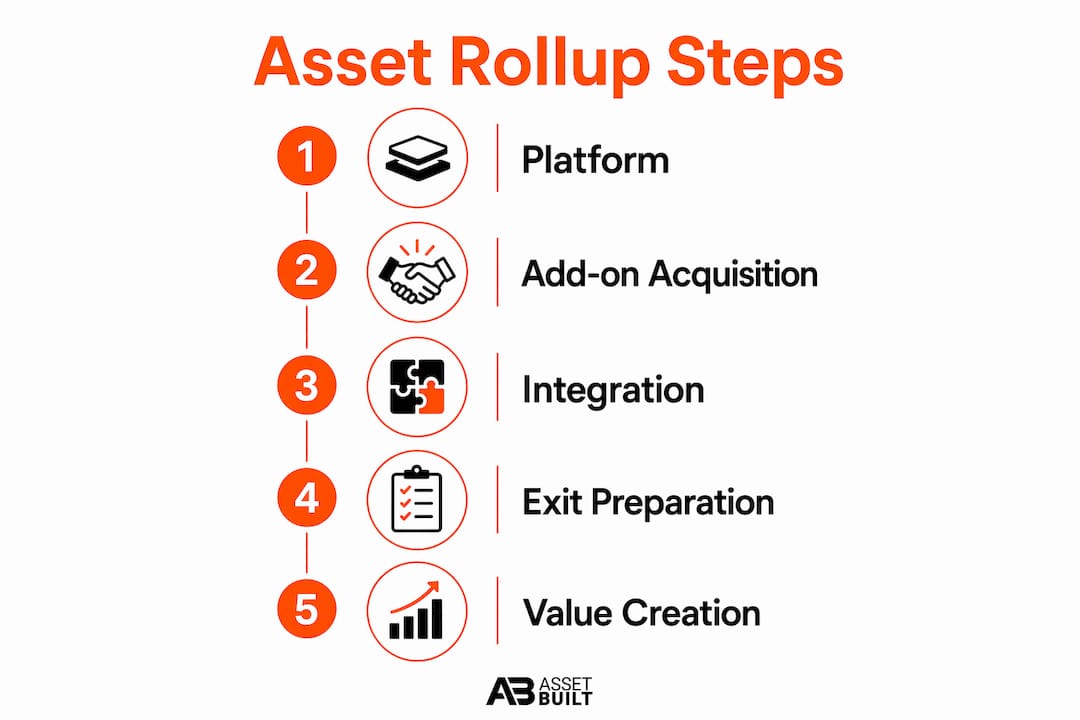
The rollup acquisition strategy follows a structured sequence. Each phase builds on the previous one, and skipping steps is the most common cause of failed consolidations.
1. Select and acquire the platform company
The platform company is the foundation of the entire rollup. It must have proven management, scalable systems, and sufficient EBITDA to absorb future add-ons. A well-chosen platform company fundamentally influences the success trajectory of the entire roll-up. Suboptimal platform selection constrains every value creation effort that follows.

2. Identify and acquire add-on targets
Add-on acquisitions are smaller operators in the same sector, typically purchased at lower valuation multiples than the platform. A private equity roll-up involves purchasing a platform business with $3M–$10M EBITDA at 6x–8x multiples, then adding 10–50 smaller companies with $500K–$3M EBITDA at 3.5x–5.5x multiples over 3–5 years. The spread between those entry and exit multiples is where the financial value originates.
3. Integrate operations systematically
Each acquired company must be brought onto shared systems, reporting standards, and cultural norms. This is not a passive process. Disciplined post-merger integration requires pre-built processes and dedicated teams functioning like internal business units. Without this discipline, the result is a collection of disconnected companies rather than a unified entity.
4. Build toward exit
The exit is structured to achieve $30M–$80M EBITDA at the platform level, where the combined entity commands a premium multiple of 8x–12x. That multiple expansion, applied to a larger earnings base, produces the outsized returns that make rollups attractive to private equity sponsors and corporate acquirers alike.
Pro Tip: Map your integration playbook before signing the first add-on. Teams that build the integration engine in advance close faster, retain more management talent, and realize synergies 30–60 days earlier than those who improvise post-close.
Rollup strategies generate the greatest value in markets where no single operator controls more than a small share of total revenue. The defining characteristic is fragmentation. Roll-up strategies in 2026 are heavily concentrated in sectors such as home services, healthcare services, professional services, and specialty distribution, precisely because thousands of small operators are available for consolidation.
The sectors that consistently produce the best rollup outcomes share several traits:
SectorFragmentation driverPrimary synergyHome servicesGeographic dispersionShared dispatch and procurementHealthcare servicesIndependent practice modelCentralized billing and complianceProfessional servicesFounder-led ownershipUnified brand and cross-sellingSpecialty distributionRegional supplier relationshipsVolume purchasing discounts
Scale and density drive margins in these sectors because fixed costs spread across more revenue. A regional HVAC platform with 15 locations, for example, negotiates equipment pricing that a single-location operator cannot access.
The financial case for a rollup rests on two distinct value drivers: multiple arbitrage and operational synergies. Both must work together. Arbitrage alone, without synergy realization, produces a fragile platform that underperforms at exit.
Multiple arbitrage is the mechanism where smaller companies acquired at 4x–6x EBITDA consolidate into a larger platform that exits at 8x–12x, creating value through multiple expansion. That spread, applied to a materially larger EBITDA base, compounds the return significantly. A platform that grows from $5M to $50M EBITDA while expanding its exit multiple from 5x to 10x produces a 20x increase in enterprise value.
Operational synergies such as procurement leverage, shared overhead, centralized back-office functions, and optimized pricing contribute materially to value creation beyond arbitrage. These synergies are not automatic. They require active management and a willingness to standardize processes across acquired companies.
The risks are equally concrete:
Pro Tip: Run a pre-acquisition integration audit on every add-on target. Assess their ERP systems, HR practices, and customer contract structures before signing. Surprises discovered post-close are always more expensive to resolve.
Integration is where rollup strategies succeed or fail. The acquisition itself is the easier part. Building a repeatable integration engine is the harder, more consequential work.
Successful roll-up strategies require a permanent change to M&A operations, establishing dedicated teams and processes that treat integration as an ongoing business function rather than a series of ad hoc mergers. This means hiring integration managers, standardizing onboarding checklists, and setting 90-day and 180-day performance benchmarks for every acquired company.
The platform company sets the tone for all of this. Its leadership team, reporting cadence, and cultural norms become the template that every add-on is measured against. Platform acquisition failures often stem from overlooked cultural fit, leadership weaknesses, or insufficient systems scalability, and these problems cascade into complex integration challenges across all subsequent acquisitions.
Post-merger integration steps that consistently separate high-performing rollups from underperformers include:
“Value in rollups comes primarily from multiple arbitrage and operational synergies post-integration, not just from the acquisitions alone. Buyers must build repeatable integration engines as core business units to sustain value creation, rather than treating acquisitions as isolated deals.”
Roll-Up Strategy: How it Works, High-Growth Approach
One distinction that financial executives often miss: the term “rollup” also appears in financial reporting contexts, where it refers to data aggregation across accounts. Distinguishing corporate M&A rollups from data rollups is standard practice in 2026, particularly when strategy and technology teams share the same vocabulary. Misalignment here creates real confusion during integration planning.
A rollup strategy creates value through multiple arbitrage and operational synergies, but only when platform selection and integration discipline are executed without compromise.
PointDetailsPlatform selection is foundationalA weak platform constrains every add-on acquisition and limits exit multiple potential.Multiple arbitrage drives returnsBuying add-ons at 4x–6x and exiting the platform at 8x–12x creates compounding enterprise value.Integration must be systematicPre-built processes and dedicated integration teams are required to unify acquired companies.Sector fragmentation determines fitHome services, healthcare, and professional services offer the highest rollup applicability in 2026.Speed is a risk, not an advantageRushed acquisitions produce due diligence gaps that compress exit valuations.
By Jake Freedlander
After working through multiple rollup transactions across industrial and operating business sectors, the pattern I see most often is this: executives underestimate how much the platform company’s culture shapes the entire program. They focus on EBITDA multiples and synergy models, which are important, but they treat culture as a soft variable. It is not. A platform with a command-and-control management style will repel the founder-operators who run the best add-on targets. Those founders built something. They will not stay if they feel absorbed rather than partnered.
The second thing most guides skip is the distinction between financial data rollups and M&A rollups. I have sat in rooms where the CFO and the CTO were using the word “rollup” to mean completely different things. The CFO was talking about acquisition strategy. The CTO was talking about data aggregation in Salesforce FSC. That misalignment delayed integration planning by weeks. Establishing a shared vocabulary across functions is not administrative overhead. It is a prerequisite for execution.
My honest view on the future of rollups in fragmented industries: the window for easy arbitrage is narrowing. Multiples on add-on targets have risen as more capital has chased the same playbook. The firms that will outperform are those with genuine operational expertise in the target sector, not just financial engineering. The business advisory function matters more now than it did five years ago, because the edge comes from integration quality, not just deal volume.
Assetbuilt operates across the full lifecycle of complex asset and operating business transactions, from advisory and capital alignment through final execution. For financial executives building or exiting a rollup platform, that full-lifecycle capability matters at every stage.
Assetbuilt’s asset solutions support rollup clients with disposition, valuation, and capital services that align with consolidation timelines. Whether the need is surplus asset monetization during integration, capital structuring for the next add-on, or advisory support ahead of an exit, Assetbuilt brings execution depth across industrial, real estate, and operating business transactions. The capital services team works directly with acquirers to align financing structures with rollup pacing and exit objectives. Contact Assetbuilt to discuss how its execution platform fits your consolidation program.
An asset rollup strategy is the acquisition and consolidation of multiple smaller companies in the same fragmented market into a single, larger platform entity. The goal is to achieve multiple arbitrage, economies of scale, and operational synergies that increase enterprise value at exit.
Multiple arbitrage occurs when add-on companies are acquired at lower EBITDA multiples (4x–6x) and the combined platform exits at a higher multiple (8x–12x). The spread between entry and exit multiples, applied to a larger earnings base, drives the primary financial return.
Home services, healthcare services, professional services, and specialty distribution are the sectors most suited to rollups in 2026, due to high fragmentation and the absence of dominant market players.
A standard private equity rollup runs 3–5 years from platform acquisition through exit, targeting $30M–$80M EBITDA at the platform level before seeking a buyer or public market transaction.
Poor platform selection is the highest-risk factor. A weak platform creates leadership, systems, and cultural deficiencies that cascade across every subsequent add-on acquisition and reduce exit valuations.